
Hernia Surgeon in Bopal

If you’re searching for an experienced, ethical surgeon for hernia treatment, Dr. Jaydeep Maheshwari offers accurate diagnosis, modern laparoscopic treatment, and a clear, patient-first approach to hernia care. Based in Bopal Ahmedabad, he focuses on safe surgical planning, minimally invasive techniques, and honest communication so patients understand exactly what to expect before, during, and after treatment.
What is a Hernia?
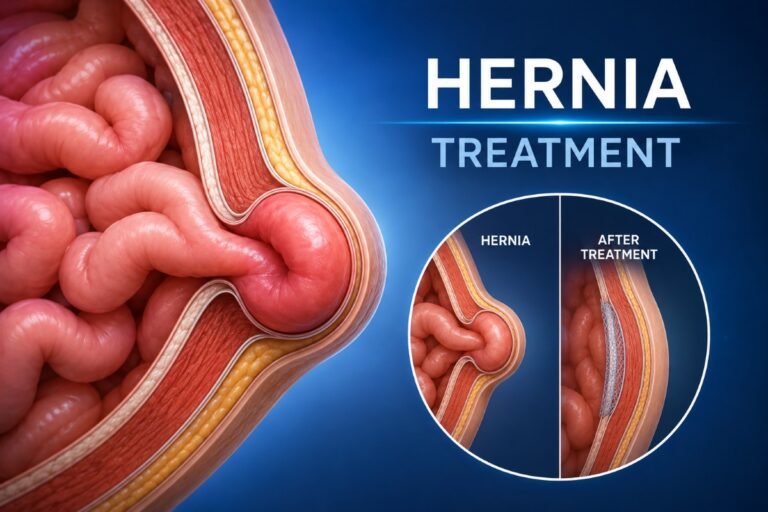
A hernia develops when an internal organ or tissue pushes through a weak point in the abdominal wall muscles, creating a visible bulge or swelling. This most commonly happens in the groin, around the belly button, at the site of a previous surgical scar, or in the upper abdomen, between the chest and navel.
Hernias can develop gradually due to age-related muscle weakening, or suddenly following heavy lifting, chronic coughing, obesity, or pregnancy. Often it’s a combination: an existing weak spot in the abdominal wall plus increased pressure that eventually pushes tissue through.
Some hernias cause little discomfort at first, appearing only as a soft lump during activity. Others come with persistent pain or heaviness that grows more noticeable while standing, coughing, or lifting weight. Left untreated, a hernia tends to enlarge over time and can, in some cases, trap or restrict blood supply to the affected tissue, turning into a surgical emergency.
+91 - 96018 08681
Types of Hernia We Treat
Inguinal Hernia : A bulge in the groin region, one of the most common types, particularly in men.
Umbilical Hernia : Swelling around the belly button, often seen after pregnancy, obesity, or repeated abdominal strain.
Incisional Hernia : Develops at the site of a previous surgical incision, where the abdominal wall has weakened.
Ventral Hernia : A general weakness in the abdominal wall along the midline, unrelated to a specific prior surgery.
Epigastric Hernia : A bulge between the chest and navel, typically small but capable of causing persistent discomfort.
- Recurrent Hernia : A hernia that returns after a previous repair, requiring more careful surgical planning.
Signs & Symptoms of Hernia
You should consult a doctor if you notice any of the following:
A visible bulge or swelling in the abdomen or groin
Discomfort or pain that increases with standing, coughing, or lifting
A dragging or heavy sensation in the affected area
Swelling that grows larger over time or changes shape
A lump that cannot be pushed back in, especially with sudden severe pain and nausea (this needs urgent medical attention)
Early consultation helps prevent complications, keeps treatment options simpler, and generally leads to a smoother recovery overall.
How Hernia is Diagnosed?
Diagnosis typically starts with a detailed physical examination to check for a visible or palpable bulge, often asking the patient to cough or strain to make the hernia more apparent. Depending on the case, additional tests may be recommended, including:
Ultrasound — to assess the hernia’s size, content, and exact location
CT Scan — for a detailed view of the abdominal wall defect and any internal involvement
MRI — occasionally used for complex, deep-seated, or unclear cases
These investigations help confirm the hernia type and severity, and guide the most appropriate treatment plan for each patient.
Hernia Treatment Options
Open (Traditional) Hernia Surgery : A conventional method involving a single incision, typically used for larger, complicated, or certain recurrent hernias where direct access to the tissue is needed.
Laparoscopic Hernia Repair : A minimally invasive technique performed through a few small incisions using a camera and specialized instruments. This approach is generally associated with less post-operative pain, minimal scarring, and a quicker return to daily activities compared to open surgery.
Mesh Repair — Why It’s Used : Surgical mesh is commonly placed to reinforce the weakened area of the abdominal wall, providing long-term structural support and reducing the chances of the hernia recurring. Dr. Jaydeep Maheshwari decides the type of mesh and its placement based on the specific hernia, its location, and individual patient factors, rather than applying the same approach to every case.
Why Choose Laparoscopic Hernia Repair?
Compared to traditional open surgery, laparoscopic hernia repair offers several practical advantages for patients managing work, family, and daily responsibilities:
Smaller incisions instead of one large cut
Less post-operative pain due to reduced tissue trauma
Faster recovery, allowing many patients to resume light activity sooner
Minimal visible scarring, which fades further over time
Shorter hospital stay, with several cases managed as day-care or short-stay procedures
Lower infection risk, since smaller wounds reduce exposure
That said, suitability for laparoscopic repair depends on the individual case, hernia size, and overall health, which is why a proper evaluation always comes before any treatment recommendation.
Why Choose a Hernia Surgeon in Bopal Who Puts Patients First?
Patients across Bopal continue to choose Dr. Maheshwari for hernia surgery for a few consistent reasons:
Careful Surgical Planning — Every treatment decision is guided by diagnostic findings and individual patient factors, not a one-size-fits-all approach.
Modern Techniques — Contemporary laparoscopic and laser methods are used wherever clinically suitable for the patient’s condition.
Clear Communication — Your condition and treatment options are explained in plain, understandable language, without unnecessary medical jargon.
Ethical Practice — Recommendations are based purely on medical necessity, never on upselling unnecessary procedures.
Personal Attention — Each patient receives individualized care and enough time to ask questions, rather than a rushed consultation.
- Structured Aftercare — Post-surgery guidance covers diet, activity, and follow-up visits to support a smooth, complication-free recovery.
What to Expect: Before and After Surgery
Before Surgery: A detailed diagnosis, including physical examination and imaging if required, confirms the hernia type and size. Your surgeon will walk you through the procedure itself, the expected recovery timeline, and any preparation needed beforehand, such as avoiding heavy lifting, managing existing health conditions, and following a light, easy-to-digest diet in the days leading up to surgery.
After Surgery: Most patients experience manageable discomfort, with pain reducing significantly within the first few days after the procedure. Many are able to walk within a few hours of surgery, which helps speed up overall recovery. Depending on the hernia type and the procedure performed, hospital stay may range from a same-day discharge to a short admission of 24–48 hours.
Light activity and desk work often resume within a week, with full recovery typically achieved over the following two to four weeks. Clear aftercare instructions cover wound care, diet, a gradual return to physical activity, and scheduled follow-up visits to make sure healing is progressing as expected.
Book a Consultation with a Trusted Hernia Surgeon in Bopal
If you’ve noticed a bulge, discomfort, or swelling that could indicate a hernia, don’t wait for it to worsen. Dr. Jaydeep Maheshwari offers a thorough evaluation, honest guidance, and modern laparoscopic treatment options tailored to your specific condition. From your first consultation through surgery and recovery, every step is handled with careful clinical judgment and genuine patient-first care. Contact Us to Book Your Appointment today!